Japanese superstitions and their meanings often connect everyday actions to ideas about luck, death, health, and good fortune. You may hear that sticking chopsticks upright in rice is unlucky, that the number four should be avoided, or that a fortune slip can predict the year ahead. These beliefs are familiar to many people in Japan, but they are not followed by everyone, and their meanings can vary by family, region, and generation. Some are old folk beliefs; others are customs, calendar traditions, or religious practices that are sometimes described as superstitions. This guide explains several well-known examples, the reasoning behind them, and how to approach them respectfully without assuming that every person in Japan believes the same things.
What Counts as a Japanese Superstition?
A superstition is a belief that an action, object, number, or event can bring good or bad luck, often without a clear cause-and-effect explanation. In Japan, some such beliefs are closely tied to language: a number may sound like an unlucky word, for instance. Others reflect funeral customs or long-standing folk explanations.
It also helps to distinguish superstition from religious practice and etiquette. Visiting a shrine at New Year, drawing a fortune, or carrying a protective charm may have a spiritual or cultural meaning, but these activities do not automatically amount to superstition. People may participate for personal, family, or seasonal reasons, and their interpretations differ.
Unlucky Numbers: Four and Nine
Two numbers often associated with bad luck are four and nine. The association comes from their possible Japanese readings:
- Four can be read as shi (し), which sounds like 死, meaning “death.” It can also be read as yon (よん), so the number is not always avoided.
- Nine can be read as ku (く), which sounds like 苦, meaning “suffering” or “distress.” It also has another common reading, kyū (きゅう).
Because of these associations, some people or institutions may avoid certain room, floor, or gift numbers. Practices vary: one hotel, hospital, or household may take extra care with numbers, while another may not. It is better to see this as a familiar cultural association than as a rule that applies everywhere.
The number eight is sometimes considered auspicious because the kanji 八 (hachi) widens toward the bottom, a shape traditionally interpreted as opening outward. This visual association is sometimes described with the word suehirogari (末広がり), meaning “broadening toward the end” or “prosperity that expands.” Interpretations of lucky numbers, like unlucky ones, depend on context and personal preference.
Funeral-Related Beliefs and Chopstick Etiquette
Some everyday taboos make more sense when viewed alongside Japanese funeral customs. Two familiar examples concern chopsticks and sleeping direction.
Don’t stand chopsticks upright in rice
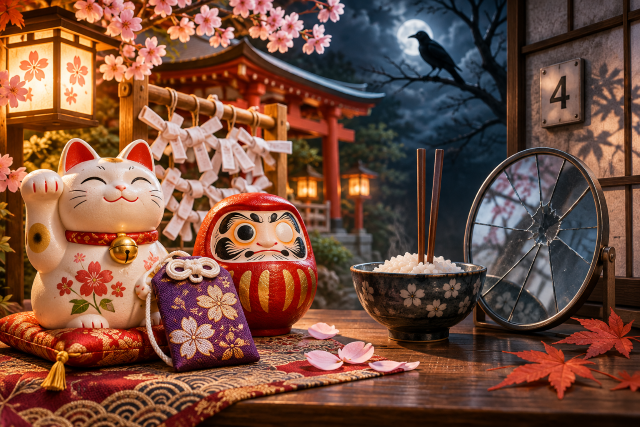
Sticking chopsticks vertically into a bowl of rice is widely considered inappropriate. At Buddhist funerals in Japan, a bowl of rice may be placed as an offering, with chopsticks standing upright in it. The resemblance can bring funeral associations to an ordinary meal.
Passing food directly from one pair of chopsticks to another is also generally avoided. At cremation ceremonies, relatives may use chopsticks to pass bone fragments to one another as part of the funeral process. At the dinner table, people usually place food on someone else’s plate instead.
These practices are more than abstract ideas about luck: they are also everyday etiquette. If you are eating with others, avoid both gestures unless you have a specific reason to use them.
Avoid sleeping with your head pointing north
The expression kita-makura (北枕) means “north pillow,” or sleeping with your head toward the north. Some people consider this unlucky because a deceased person is traditionally laid out with the head pointing north in certain Buddhist funeral settings. The association has led to the idea that people should avoid sleeping that way.
Beliefs about this vary, and not everyone pays attention to sleeping direction. If you are arranging a room, there is usually no need to worry unless someone you are staying with raises the issue.
Everyday Beliefs About Actions and Omens
Several Japanese folk beliefs attach significance to small actions. Their explanations are not always consistent, and a saying may be more familiar in some households than in others.
Cutting your nails at night
A common warning says not to cut your nails at night. One explanation links the phrase to fear of being unable to be present when one’s parents die: a wordplay-based interpretation connects nighttime nail cutting with an untimely death or separation. The precise explanation is not universal, and the saying is often repeated as a family warning rather than a literal prediction.
Whistling after dark
Some people warn against whistling at night. Depending on the version, the sound is said to attract snakes, spirits, or thieves. Such beliefs reflect an older world in which a noise outside after dark might signal danger. Today, someone may repeat the warning playfully or simply ask for quiet.
Hiding your thumbs when a hearse passes
A folk belief says to hide your thumbs when you see a hearse. In Japanese, a thumb is called oya-yubi (親指), literally “parent finger.” One explanation connects covering it with protecting one’s parents from death or misfortune. The belief is not universally observed, but it is a memorable example of how word associations can shape customs.
The lucky tea stalk
A tea stalk standing upright in a cup is sometimes called chabashira (茶柱), literally “tea pillar.” It is treated as a sign of good luck. Since this is an accidental occurrence, noticing one can turn an ordinary cup of tea into a small, cheerful omen. As with many folk beliefs, people may enjoy the idea without taking it as a firm prediction.
Auspicious Days and Yearly Fortunes
Not all beliefs about luck are attached to gestures. Some are connected to calendars, life stages, or seasonal customs.
Rokuyō: lucky and unlucky calendar days
The rokuyō (六曜) are a cycle of six labels found on some Japanese calendars. The best-known is taian (大安), commonly treated as an auspicious day for events such as weddings. Butsumetsu (仏滅) is commonly regarded as an inauspicious day, and some people may avoid scheduling important celebrations on it.
Despite its name, Butsumetsu is part of the rokuyō calendar system; it should not be taken as proof that the day has a particular meaning in Buddhist doctrine. Attitudes vary, and many people do not plan around these labels. Still, they can influence choices for events where family expectations or preferred dates matter.
Yakudoshi: ages associated with misfortune
Yakudoshi (厄年) refers to ages traditionally regarded as vulnerable to misfortune or difficulty. The idea is connected with life transitions and the challenges that may come with them, rather than with a guaranteed bad event. Certain ages, including 42 for men and 33 for women in many commonly cited lists, are often highlighted. Exact ages and ways of counting can differ, so a shrine or temple may provide its own guidance.
Some people visit a shrine or temple for yakuyoke (厄除け), a prayer or ritual intended to ward off misfortune. Others treat yakudoshi as a reminder to take care during a demanding stage of life. The practice is optional, and it does not mean someone expects disaster.
Omikuji: fortune slips at shrines and temples
An omikuji (おみくじ) is a written fortune available at many shrines and temples. It may offer a general prediction and advice about areas such as travel, work, or relationships. Fortunes are often arranged in degrees, from especially favorable to unfavorable, though the wording and categories vary.
Visitors may keep a favorable slip or tie a less favorable one at a designated place, following the site’s instructions. There is no single rule that everyone follows. Many people approach omikuji as a seasonal custom or a prompt for reflection rather than a certain forecast.
How to Respond to Superstitions as a Visitor
You do not need to memorize every belief to be a considerate visitor. A few practical guidelines are enough:
- Avoid standing chopsticks in rice or passing food directly between pairs of chopsticks.
- If someone mentions an unlucky number or a custom in their home, follow their preference where it is easy to do so.
- Treat shrine and temple practices with respect, but do not assume that every Japanese person follows the same beliefs.
- If you are unsure whether an action is a taboo, watch what others do or ask politely.
Most of all, avoid turning a folk belief into a sweeping claim about Japanese people. Someone may believe in the omen, know it only as a saying, or regard it as harmless fun.
Frequently Asked Questions
Are Japanese people very superstitious?
There is no single answer. Some people take particular customs seriously, while others treat them as cultural sayings or ignore them. Beliefs can vary with family, region, age, and situation.
Is the number four always avoided in Japan?
No. Four can be read as shi, which sounds like “death,” but it can also be read as yon. Some people or organizations avoid certain uses of the number; many others do not.
What should I do if I receive an unlucky omikuji?
Follow any instructions at the shrine or temple, such as tying the slip in a designated area, if you wish. An unfavorable fortune is not a guaranteed prediction. You can also read it as advice to act thoughtfully.
Conclusion
Japanese superstitions and their meanings offer a window into the way language, funeral customs, calendars, and everyday life can shape ideas about luck. The number four may sound like “death,” upright chopsticks may recall funeral rites, and a tea stalk in a cup may be welcomed as a lucky sign. But these beliefs are not universal rules. Some people observe them closely, some enjoy them as traditions, and others give them little thought. For visitors, the most useful approach is to learn the meaning behind a few well-known customs, show consideration when someone expresses a preference, and stay curious without making assumptions.