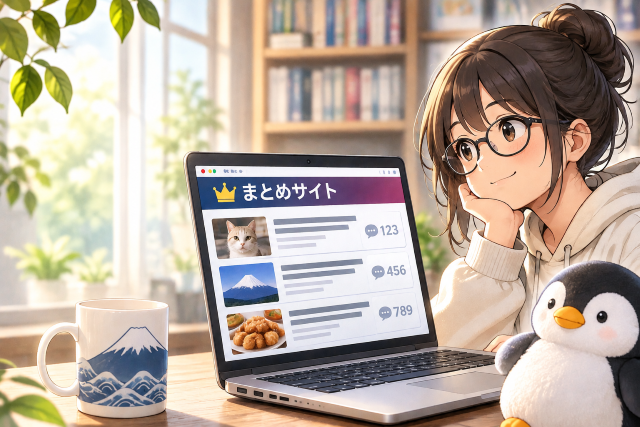
Matome sites (まとめサイト) are Japanese websites that collect and organize information from online forums, social media, news articles, and other sources. They are particularly well known for turning long discussions on anonymous message boards into shorter, easy-to-read articles.
These sites have become a recognizable part of Japanese internet culture. Some offer entertaining collections of jokes and online reactions, while others cover news, technology, entertainment, and everyday topics. However, because editors decide which comments to include, a matome article does not necessarily reflect the full discussion or broader public opinion.
What Does “Matome” Mean in Japanese?
The Japanese word matome (まとめ) comes from matomeru (まとめる), meaning “to gather,” “organize,” or “summarize.” A matome site is therefore a website that brings information together in one place.
In Japan, the term can describe several kinds of websites, including collections of useful information and links. However, when Japanese internet users talk about matome sites, they often mean websites or blogs that compile comments from anonymous discussion boards.
These are sometimes called matome blogs (まとめブログ). They typically select interesting posts from a discussion, arrange them into a readable sequence, and publish them with an attention-grabbing headline.
Unlike traditional news websites, which generally produce their own reporting, many matome blogs primarily reorganize material created by other internet users.
How Matome Sites Became Popular in Japan
The development of matome blogs is closely connected to Japan’s anonymous message board culture.
One of the most influential platforms was 2channel (2ちゃんねる), commonly known as 2ch. Launched in 1999, it became a major gathering place for Japanese internet users to discuss news, entertainment, technology, personal experiences, and countless other topics. Its history is closely connected to today’s 5channel (5ちゃんねる).
Discussions on these boards could contain hundreds or thousands of comments. Reading an entire thread was often time-consuming, especially when it included unrelated conversations, jokes, and arguments.
Matome blogs offered a convenient alternative. Editors selected noteworthy comments, removed much of the surrounding discussion, and presented the results as a shorter article.
For example, a thread about a strange experience at work might be turned into a humorous story. A discussion about a new video game could become a collection of positive and negative reactions. Readers could enjoy the highlights without visiting the original forum.
As social media grew, some matome sites also began collecting posts from platforms such as X (formerly Twitter).
Famous Examples of Japanese Matome Sites
Several websites help illustrate the different forms of Japanese matome culture.
Hamster Sokuho (ハムスター速報)
Hamster Sokuho is a well-known Japanese matome blog that has featured online discussions, amusing stories, news-related reactions, and other internet topics. Its content reflects the entertainment-oriented side of matome culture.
Itai News (痛いニュース)
Itai News is another prominent example, known for covering unusual news stories, controversial topics, and reactions from internet users. It illustrates how matome blogs can combine news-related material with selected online commentary.
NAVER Matome (NAVERまとめ)
NAVER Matome was a popular Japanese content-curation service that allowed users to create collections of links, images, and information on particular topics.
Unlike forum-based matome blogs, it focused on a wider variety of curated content, including lifestyle tips, entertainment, and practical information. The service ended in 2020.
These examples show that matome sites are not all the same. Some focus on anonymous online discussions, while others organize information from many different sources.
How Do Matome Sites Work?
Although their formats vary, many forum-based matome blogs follow a similar process.
First, an editor finds an interesting discussion or collection of social media posts. The editor then chooses particular comments, arranges them in an order that is easy to follow, and adds a headline. Some articles also include images, explanations, or links to related information.
The result may resemble a conversation, but it is an edited version of the original discussion.
For example, imagine that an online thread contains 100 comments about a newly opened restaurant. Some users praise the food, others complain about the service, and many discuss unrelated subjects.
A matome editor might select only the funniest complaints and publish an article suggesting that the restaurant is receiving terrible reviews. Another editor could use the same discussion to create a positive article.
Neither version necessarily represents the entire conversation.
Many matome sites earn revenue through advertising or affiliate links. This business model is not inherently problematic, but it can encourage publishers to choose topics and headlines that attract more clicks.
Why Are Matome Sites Popular?
One major reason is convenience. Readers can quickly understand the highlights of a long discussion without spending time searching through hundreds of individual posts.
Matome sites also provide entertainment. Japanese internet forums have developed their own jokes, slang, storytelling conventions, and humorous exchanges. A well-edited compilation can make these conversations accessible to people who do not regularly visit the original forums.
Another attraction is the variety of topics. A reader might find an amusing personal story, reactions to a television program, technology discussions, or opinions about a recent news event.
For people learning Japanese, matome sites can also offer exposure to informal language. However, many expressions are highly casual, sarcastic, or specific to particular online communities. They should not automatically be copied into everyday conversations.
Are Matome Sites Reliable?
The reliability of a matome site depends on its sources and editorial practices.
The most important point is that selected online comments are not the same as public opinion. A collection of reactions from one discussion board cannot establish what Japanese people as a whole think about a subject.
Context is another concern. An editor may omit replies, corrections, or explanations that change the meaning of a comment. Sarcasm and jokes can also be difficult to recognize when separated from their original discussion.
Readers should be particularly careful with articles about politics, health, financial matters, or breaking news. A matome article may be useful for discovering a topic, but important factual claims should be checked against reliable reporting or official sources.
Copyright and privacy can also become issues when websites republish text, images, or personal information. Material being publicly accessible online does not automatically mean that every form of reuse is permitted or appropriate.
None of this means that all matome sites are untrustworthy. Some provide useful links and context. The key is to understand that an edited compilation presents a particular selection of information.
How to Read Japanese Matome Sites Wisely
If you want to explore Japanese matome culture, a few simple habits can help:
- Check the original source. Look for links to the discussion, social media posts, or news reports being summarized.
- Read beyond the headline. A dramatic title may exaggerate the importance of a few comments.
- Pay attention to dates. Old discussions can resurface long after the information becomes outdated.
- Distinguish opinions from facts. Anonymous comments are not necessarily verified information.
- Avoid generalizing. A handful of comments cannot represent the views of an entire country.
To find these websites in Japanese, try searching for まとめサイト (matome saito) or まとめブログ (matome burogu).
FAQ
Are matome sites the same as Japanese news websites?
No. Although some matome sites cover current events, many primarily collect and reorganize comments or information from other sources. Traditional news organizations generally produce original reporting, while matome blogs often focus on presenting existing online discussions.
Can matome sites help me learn Japanese?
Yes. They can introduce you to casual Japanese, internet slang, and online humor. However, the language may contain abbreviations, sarcasm, or expressions that are inappropriate in formal situations.
Do matome sites represent what Japanese people think?
Not necessarily. They reflect the comments selected by an editor, often from a particular online community. They should not be treated as representative surveys of Japanese public opinion.
Conclusion
Matome sites are a distinctive part of Japanese internet culture, especially those that transform lengthy anonymous forum discussions into short, entertaining articles. Websites such as Hamster Sokuho and Itai News illustrate how online conversations can be repackaged for a wider audience.
They offer a convenient way to discover Japanese internet humor, slang, and popular discussions. However, their content is shaped by editorial choices, and selected comments do not always provide a balanced or accurate picture.
For international readers, matome sites are best enjoyed as a window into particular corners of Japan’s online world—not as a definitive guide to what Japanese society thinks.