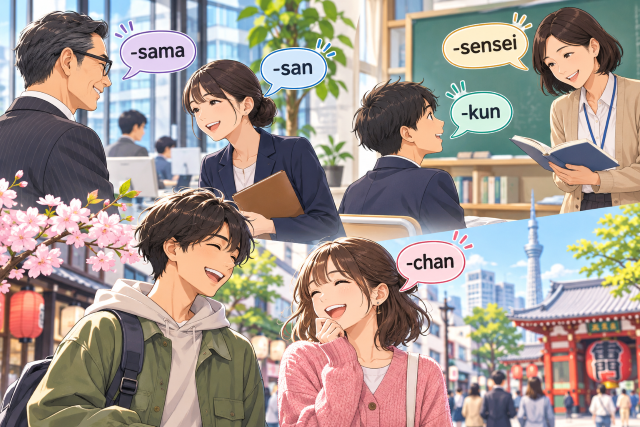
Japanese honorifics such as san, chan, kun, and sama are short name endings that communicate respect, familiarity, or social relationship. The safest choice for most learners is san (さん), a polite, widely used form that works in many everyday situations. Chan (ちゃん) often sounds affectionate or familiar, kun (くん or 君) is common for boys and men but is not limited to them, and sama (様) expresses a higher degree of respect. Their meanings depend on context, not just a person’s age or gender. This guide explains what each honorific suggests, how to choose one, and what international visitors and Japanese learners should avoid.
What Are Japanese Honorifics?
Japanese honorifics are words or suffixes that express respect and social relationships. The four forms in this guide usually follow a person’s name:
- Tanaka-san — Tanaka with a polite, neutral honorific
- Yuki-chan — Yuki with an affectionate or familiar tone
- Sato-kun — Sato with a familiar or status-marked tone
- Mori-sama — Mori with a highly respectful tone
In Japanese, these are written as 田中さん (Tanaka-san), ゆきちゃん (Yuki-chan), 佐藤くん (Sato-kun), and 森様 (Mori-sama). The honorific generally comes after the name, unlike English titles such as “Mr.” or “Ms.,” which come before it.
These name endings are one part of Japanese keigo (敬語), the broader system of respectful and polite language. They do not translate neatly into fixed English titles. A suffix can show politeness, closeness, a workplace relationship, or a speaker’s view of the other person—all at once.
San (さん): The Safest Everyday Choice
San is the most versatile option for addressing someone politely without sounding excessively formal or intimate. It is commonly used with surnames, as in Suzuki-san (鈴木さん). It can also follow a given name, particularly when that is how someone introduces themselves or how people in a particular setting address one another.
For learners who are unsure which honorific to choose, san is usually a sensible starting point. It works in many conversations with adults, colleagues, acquaintances, and people you have just met. It is not exactly equivalent to “Mr.,” “Mrs.,” or “Ms.,” since it does not specify gender or marital status.
San is not restricted to people. In everyday Japanese, it may also be attached to the names of some businesses, occupations, or animals. For example, honya-san (本屋さん) can mean “bookstore” or refer politely to someone who runs one, depending on context. These uses are familiar conventions, not a reason to add san to every noun.
When san may not fit
Although san is broadly useful, it is not universal. A person may prefer a different form of address, or a workplace may use job titles instead of name suffixes. In some situations, Japanese speakers omit honorifics as part of an established close relationship or because a person has invited them to do so.
Japanese speakers commonly avoid adding an honorific to their own name when speaking about themselves. They may also use different wording for members of their own family when speaking to people outside it, reflecting a wider pattern of showing respect toward the listener or the listener’s group. These conventions depend on context, so learners need not imitate them without understanding the situation.
Chan (ちゃん): Affectionate and Familiar
Chan often conveys affection, closeness, or a cute or gentle impression. Adults may use it for children, and friends or family members may use it for one another. It is also frequently heard in nicknames and in some names for pets.
It is often associated with girls and women, but it is not exclusively feminine. It can be used for boys, men, and people of any gender in relationships where the affectionate or playful tone feels appropriate. The choice depends on the speaker, the person being addressed, and the social setting.
For example, a family member might call a child Hana-chan. Close friends might use -chan as part of a nickname. But using it for someone you have just met can sound overly familiar or patronizing, especially if there is no shared relationship that makes the tone welcome.
Chan is also used in some public nicknames and character names. Seeing it in a name does not mean it is suitable for everyone to use in every context. If you are unsure, use the form the person uses for themselves or choose san.
Kun (くん / 君): Familiar, Often Used for Boys and Juniors
Kun is commonly used for boys and younger men, especially by people who are older or in a position of authority. It is familiar rather than highly formal, and its tone changes with the relationship. A teacher might use it for a student, or a manager might use it for a junior colleague—but those patterns vary among schools, workplaces, and individuals.
The association with boys and men is common, but kun is not limited to them. In some organizations or groups, a senior person may address a junior woman with -kun. That choice may reflect the institution’s convention, the speaker’s habit, or a particular relationship; it is not a rule that all Japanese speakers follow.
Like chan, kun can sound too familiar if used without an appropriate relationship. Learners should not assume that a person’s gender alone determines whether kun is suitable. Follow local conventions and the preferences of the person being addressed. If you do not know those conventions, san is generally a safer option.
Why Are Politicians Called Kun in Japan?
Interestingly, kun is also traditionally used in Japan’s National Diet (parliament), where lawmakers are addressed with this honorific regardless of their gender or age. For example, a female politician may be called Tanaka-kun (田中君) during a parliamentary session, just like a male colleague.
Unlike its familiar use in everyday conversation, kun in this setting is a formal parliamentary convention rather than a sign of closeness or lower status. The tradition can seem surprising even to Japanese people, since adults rarely use kun when addressing senior figures in ordinary situations. However, some lawmakers have begun using san instead, reflecting changing attitudes toward traditional forms of address.
Sama (様): High Respect and Formality
Sama is a highly respectful honorific, often used for customers, clients, guests, and people being addressed in formal written communication. For instance, a company may address a customer as Tanaka-sama (田中様). In a letter or package, the name may be followed by the written form 様.
The suffix also appears in set expressions and religious contexts. Kami-sama (神様), for example, means “god” or “deity” with a respectful nuance. In customer service, using sama can signal formal respect, but it does not mean the speaker is personally close to the recipient.
Because it is more formal than san, sama can sound exaggerated in ordinary conversation if used without a reason. It is not a general-purpose way to show extra warmth. Use it when you see it in an established formal context, rather than upgrading every name to -sama.
A related form, dono (殿), may appear in formal documents and some official contexts. It is not a casual substitute for sama in everyday conversation.
How to Choose the Right Honorific
A practical approach is to consider the relationship and setting before choosing a suffix:
- Use the person’s preferred form of address if you know it. This may be a surname with san, a given name, a nickname, or a title.
- When uncertain, start with san. It is a broadly appropriate choice in many polite interactions.
- Use chan or kun only when the relationship or setting supports the familiar tone. Do not infer that they are appropriate just from someone’s age or gender.
- Reserve sama for clearly formal or conventional uses. It is common in customer service and formal correspondence, but can feel too ceremonious in casual conversation.
- Follow workplace, school, and group customs. Organizations may have their own ways of addressing colleagues or students.
In Japanese, surnames often come before given names, especially in formal contexts. If someone introduces themselves by surname, using that surname with san is a reliable choice. If they invite you to use their given name or a nickname, you can follow their lead. When speaking English, many Japanese people use the naming conventions of the conversation; do not assume that a Japanese honorific must always be added.
When not to add an honorific
A person’s job title may be used instead of a name suffix. For example, Tanaka-sensei (田中先生) means “Teacher Tanaka” or “Dr. Tanaka,” depending on the person’s role. In such cases, adding san after the title is generally unnecessary.
Honorifics are also usually not added to your own name. Saying Watashi wa Smith-san desu (“I am Smith-san”) would generally sound unnatural when introducing yourself. A simple Smith desu (“I’m Smith”) is more suitable.
Frequently Asked Questions
Can I always use san if I am unsure?
San is a good default in many everyday situations, but it is not guaranteed to fit every relationship. Follow the person’s preferred name, a group’s established practice, or a title they use. If someone corrects you, simply use the form they request.
Is it rude to leave off an honorific?
It can sound overly direct or familiar in Japanese, especially when addressing someone you do not know well. However, people may omit suffixes among close friends, family members, or in particular workplaces and groups. When speaking English, whether to use a Japanese suffix depends on the person’s preference and the conversation.
Should I use Japanese honorifics when writing someone’s name in English?
There is no single rule. Some people use -san in English-language messages, while others prefer a title, first name, or no suffix. If you are unsure, mirror how the person signs their messages or ask what they prefer.
Conclusion
Japanese honorifics san, chan, kun, and sama offer different ways to signal respect, familiarity, and social context. San is a useful polite default; chan often sounds affectionate; kun is familiar and frequently used for boys or junior colleagues; and sama marks a higher level of formality. None of these meanings is absolute, and the right choice can vary between individuals, workplaces, and generations. For learners, the most considerate habit is to notice how people address one another, use san when a polite form is needed, and follow the preference of the person you are speaking to.