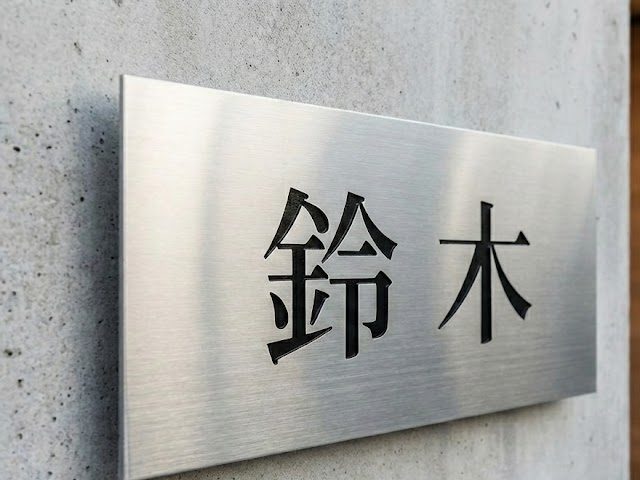
Japanese surnames are a fascinating key to understanding the country’s culture, history, and social structure. If you visit Japan and meet people named “Sato” or “Suzuki” over and over, it’s no coincidence. While it’s said that there are about 100,000 different surnames in Japan, many of them are concentrated in specific regions, and a few are overwhelmingly common.
This article will trace the history of Japanese surnames, explain why certain ones are so prevalent, and reveal how they reflect Japanese culture.
The History of Japanese Surnames: When and How Did They Emerge?
Throughout Japanese history, surnames were not always a universal part of identity.
- Ancient to Medieval Period: Surnames were primarily used by people of specific social classes, such as nobles and samurai. They used them to indicate their lineage, land ownership, or official position.
- Edo Period (1603-1868): During this time, only the samurai class was permitted to have a surname. Common people were simply called by their given name, along with their place of residence or occupation.
- Since Meiji Period (1868-): A major turning point occurred. In 1870, the government enacted a law requiring everyone to adopt a surname. This law, known as the “Heimin Myoji Hissho Gimu-rei,” gave every Japanese person a surname for the first time. Many people chose surnames based on the geography of their residence (e.g., “Yamamoto(山本)” meaning “base(本) of the mountain(山),” “Tanaka(田中)” meaning “in the middle(中) of a rice field(田)”), their occupation, or the name of an ancestor’s home region. It was during this period that the diversity of modern Japanese surnames was born.
The Top 10 Most Common Surnames in Japan
The national ranking of the most common surnames is often a three-way battle between “Sato,” “Suzuki,” and “Takahashi.” While the order may shift depending on the survey, these three almost always occupy the top spots.
Based on a recent survey, here are the top 10 most common surnames in Japan.
- Sato (佐藤): Over 1.8 million people.
e.g., Takuma Sato (佐藤 琢磨) – racing driver - Suzuki (鈴木): Over 1.7 million people.
e.g., Ichiro Suzuki (鈴木 一朗) – baseball player - Takahashi (高橋): Over 1.3 million people.
e.g., Naoko Takahashi (高橋 尚子) – marathon runner, Olympic gold medalist - Tanaka (田中): Over 1.3 million people.
e.g., Masahiro Tanaka (田中 将大) – baseball player - Ito (伊藤): Over 1 million people.
e.g., Mima Ito (伊藤 美誠) – table tennis player, Olympic gold medalist - Watanabe (渡辺): Over 1 million people.
e.g., Ken Watanabe (渡辺 謙) – actor - Yamamoto (山本): Over 1 million people.
e.g., Yoshinobu Yamamoto (山本 由伸) – baseball player - Nakamura (中村): Over 1 million people.
e.g., Shunsuke Nakamura (中村 俊輔) – soccer player - Kobayashi (小林): Over 1 million people.
e.g., Takeru Kobayashi (小林 尊) – competitive eater - Kato (加藤): Over 860,000 people
e.g., Miliyah Kato (加藤ミリヤ) – J-POP singer
These surnames alone account for roughly one in ten of the total Japanese population.
Why Is “Sato” the Most Common Surname?
The surname “Sato” (佐藤) is believed to have originated from a powerful aristocratic family, the Fujiwara clan, which dominated Japan’s politics for centuries. A prominent member of this clan, Fujiwara no Kin’ai, was granted an official title called “Saemon-no-jō” (左衛門尉). His descendants combined the first character of his official title, “Sa” (佐), with the first character of the Fujiwara clan name, “Tō” (藤), to create the surname “Satō” (佐藤). As the clan’s influence grew and its members spread throughout the country, their new surname also became widespread. This historical link to a powerful and influential family is the most widely accepted explanation for why “Sato” is the most common name in Japan today.
Why Is “Suzuki” One of the Most Common Surnames?
The surname “Suzuki” (鈴木) has a different origin. It is thought to have originated from a specific agricultural and religious practice in the Kumano region of Mie Prefecture. The word “Suzuki” literally means “bell tree,” which referred to the practice of stacking sheaves of rice onto a pole, a ritual used to pray for a good harvest. The Kumano clan, which was a powerful family in that region, held this practice in high regard. As the Kumano belief system spread throughout Japan, so did the surname. Over time, many people who had no blood relation to the original clan adopted “Suzuki” as their surname, especially after the Meiji government made it mandatory for all citizens to have a surname. This agricultural and religious connection is a key reason why “Suzuki” is so widespread today.
The Cultural Significance of Surnames
In Japan, a surname is more than just a way to identify a family. It plays a unique role in Japanese culture and society.
- A Sense of Group Belonging: Unlike in many other countries, it is common for Japanese people to address each other by their surname, not their given name, especially when meeting for the first time. This reflects a Japanese culture that places importance on the “household” and the “group” one belongs to, rather than the individual.
- An Expression of Respect: By adding the honorific suffix “-san” to a surname, you show respect to the person you are speaking to. For example, “Tanaka-san” is the most common way to address someone in business, school, and many other social contexts. It is usually not until a close relationship is established that people use first names.
From surnames born from geography and occupation to those with historical lineage, each one has a rich story behind it. Learning about these surnames is a great first step toward understanding the structure of Japanese society and how people interact with one another.


コメント